

What Is the Common Belief About Kilts and Ireland?
Kilts are iconic garments that are synonymous with Scottish culture. Many people across the world associate kilts with Scotland, and for good reason. Scottish kilts have a long and rich history, with each kilt tartan pattern representing a specific Scottish clan. However, some people believe that the Irish also wear kilts, leading to a long-standing debate on the subject. In this article, we'll explore the question, "Do Irish wear kilts?" and separate fact from fiction.
Did the Irish Historically Wear Kilts?
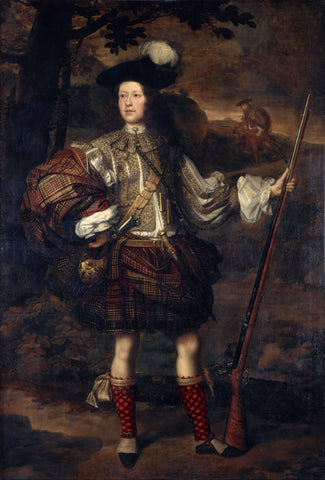
The earliest Irish garments were not kilts. Medieval Irish men typically wore a léine — a long linen tunic — often dyed saffron yellow, paired with a wool cloak (brat) and sometimes tight-fitting trousers known as trews. However, the modern notion of the kilt as a pleated, tartan garment was not part of native Irish dress.
Expert Tip from Andrew Walsh, Cultural Historian:
"The so-called 'saffron kilt' emerged not from tradition but as a symbol of Irish identity during periods of cultural resistance — especially in the 16th century."
When Did Kilts Become Part of Irish Identity?

Kilts entered Irish visual culture much later than in Scotland. The saffron kilt—a plain, mustard-yellow wrap—was adopted during the Tudor era and worn by Irish mercenaries (known as gallowglass). It reemerged in the 20th century during the Gaelic Revival as a way to assert national identity through clothing.
What Is the Difference Between Irish and Scottish Kilts?
Scottish kilts are pleated, heavily associated with clan tartans, and typically worn with ornate accessories. Irish kilts are simpler in design, often solid-colored (especially saffron), and based on county or family heritage rather than clan lineage.
|
Feature |
Irish Kilt |
Scottish Kilt |
|
Origin |
Gaelic Revival, 16th-century soldiers |
Highland tradition |
|
Color/Tartan |
Solid or county tartans |
Clan tartans |
|
Pleats |
Box pleats or none |
Knife pleats |
|
Symbolism |
National/county pride |
Clan identity |
|
Accessories |
Minimal (belt, brooch) |
Full set: sporran, sgian dubh, pin |
Are Kilts Irish or Scottish?
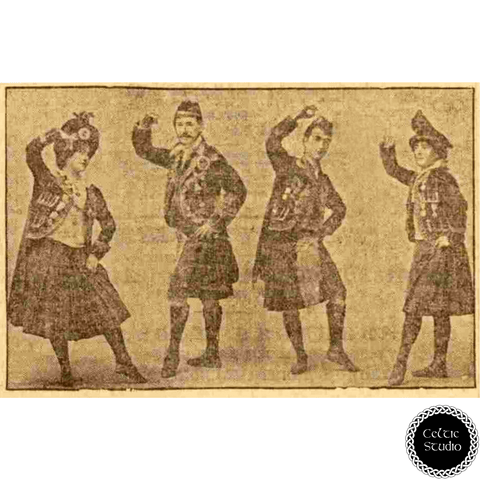
While the kilt originated in the Scottish Highlands, the Irish adopted their own form for entirely different reasons. It evolved in Ireland as a political and cultural symbol during times of colonization and revival, rather than as a familial garment.
What Are Traditional Irish Men’s Clothes?
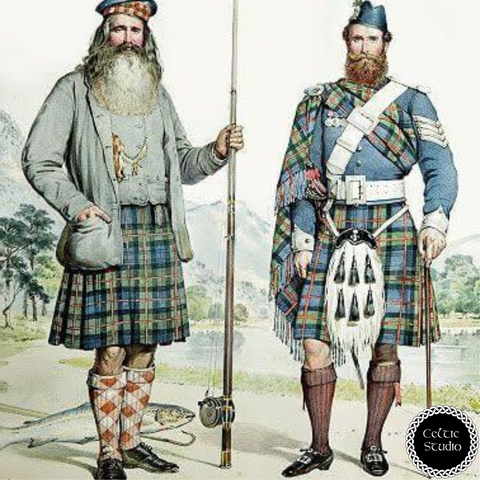
Traditional Irish dress for men included:
• Léine – a saffron-dyed shirt
• Brat – a wool cloak, fastened at the shoulder
• Trews – fitted trousers
• Saffron kilt (later addition)
The modern Irish kilt is a ceremonial evolution, not an ancient native costume.
Do the Irish Wear Kilts Today?
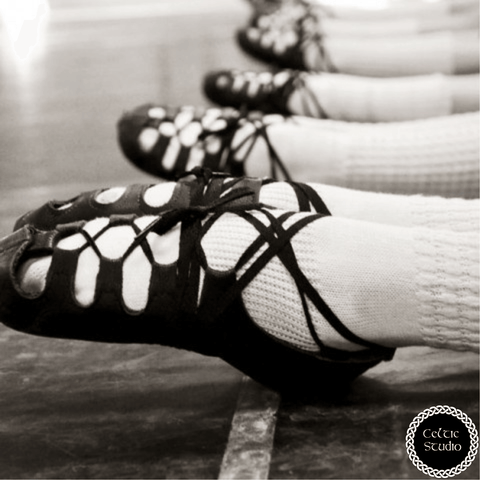
Yes — Irish kilts are worn at weddings, national celebrations, parades, and cultural events. They are particularly popular among the diaspora in North America, where cultural pride plays a significant role in identity.
What Do Irish Men Wear to Weddings?
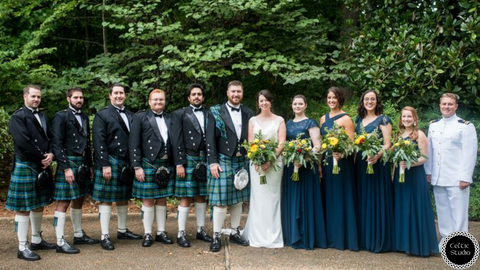
Many Irish grooms wear kilts in tartans connected to their surname or county of origin. These outfits typically include:
• Irish kilt (county or family tartan)
• Waistcoat and jacket (often Argyll or Prince Charlie style)
• Belt and buckle
• Ghillie brogues
• Optional: fly plaid or sash
Can Anyone Wear an Irish Kilt?
Unlike Scotland’s well-documented clan tartans, Irish tartans are usually:
- County tartans (e.g., Clare, Donegal, Kerry)
- Family-name tartans (e.g., Walsh, O’Donnell, Murphy)
- District-based (e.g., Ulster province)
These are modern creations, registered in tartan databases and used to express Irish roots through color and pattern.
How to Choose an Irish Kilt by Surname or County?
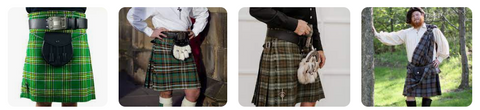
Check tartan registries such as the Scottish Register of Tartans or consult with a heritage brand like CelticStudio. Most Irish names are linked to county tartans, while others (like Walsh, O’Brien, Kennedy) have unique family patterns.
Under the Wool: Engineering of the Irish Kilt
- Saffron dye: Symbolized Catholic resistance and Gaelic pride.
- No pleats: The Irish kilt was originally a flat wrap, unlike the Scottish box or knife pleats.
- Military use: The Irish Defence Forces wore kilts in ceremonial settings until the 21st century.
- Tartan invention: Irish tartans were largely created in the late 20th century for surname and county marketing.
- Fabric weight: Irish kilts are often made from lighter wool than Scottish kilts, due to climate and context.
Summary: What Does Wearing an Irish Kilt Mean Today?
Wearing an Irish kilt today means participating in a revived tradition. It’s not an ancient practice but a modern expression of pride, heritage, and identity. Unlike Scottish clan kilts, Irish kilts speak more to nation and county than lineage, and that’s what makes them uniquely powerful.
Frequently Asked Questions
Did the Irish historically wear kilts?
Not traditionally. Irish men wore long tunics (léine) and cloaks. The kilt appeared later, especially during the Gaelic Revival and in military contexts.
What is the difference between Irish and Scottish kilts?
Irish kilts are usually solid-colored or county-based, with fewer pleats. Scottish kilts are clan-based, tartan-heavy, and worn with more accessories.
Do Irish people still wear kilts?
Yes, mostly at cultural events, weddings, and national celebrations — especially among the Irish diaspora.
Can I wear an Irish kilt if I'm not Irish?
Yes. As long as it’s done with respect, wearing an Irish kilt is a welcome way to celebrate heritage or admiration for Irish culture.
How do I find my Irish family tartan?
You can search by surname or county in official tartan registries or contact heritage retailers like CelticStudio for help identifying your pattern.
Is it a part of Irish culture to wear kilts?
While kilts are often associated with Scottish culture, there is a rich tradition of Irish kilts as well. The Irish kilt is typically made from solid-colored wool and is often worn for traditional Irish dance or as a way for grooms to connect with their Irish heritage at weddings.
Is it acceptable for an Irish man to wear a kilt?
Yes, absolutely! Kilts are a traditional garment worn by both Scottish and Irish men. Many Irish men choose to wear kilts for special occasions such as weddings or formal events, as a way to celebrate their Irish heritage.
Do the Irish use bagpipes and wear kilts as part of their cultural traditions?
While bagpipes are often associated with Scottish culture, the Irish have their own traditional musical instruments such as the uilleann pipes and the bodhrán. However, the Irish kilt is a traditional garment worn by both Scottish and Irish men.
Is it common for Irish people to wear kilts at weddings?
Yes, in recent years, Irish kilts have become a popular alternative to traditional tuxedos and suits for grooms at Irish weddings. Wearing an Irish kilt at a wedding is a way for the groom to connect with his Irish heritage and to stand out from the crowd.
What do Irish men usually wear underneath their kilts?
While it is a common misconception that Scotsmen traditionally do not wear anything under their kilts, the Irish traditionally wore a type of shorts known as a leine or léine, which were often made from linen.
Was it customary for Irish men to wear kilts in the past?
Yes, the Irish have a rich tradition of wearing kilts, although the style and construction of the Irish kilt are different from that of the Scottish kilt. The Irish kilt is typically made from solid-colored wool and is often worn for traditional Irish dance or as a way for grooms to connect with their Irish heritage at weddings.
What was the reason behind the Irish wearing kilts?
The exact origins of the Irish kilt are not known, but it is thought to have been worn by Irish warriors in ancient times. Today, the Irish kilt is often worn for traditional Irish dance or as a way for grooms to connect with their Irish heritage at weddings.
How can an Irish kilt be defined?
An Irish kilt is a traditional garment worn by both Scottish and Irish men. The Irish kilt is typically made from solid-colored wool and is often worn for traditional Irish dance or as a way for grooms to connect with their Irish heritage at weddings.
Can calling a kilt a skirt be deemed offensive?
No, calling a kilt a skirt is not necessarily offensive, but it may be seen as inaccurate or disrespectful by those who are proud of their Scottish or Irish heritage. It is best to refer to the garment by its proper name - a kilt.
Is it appropriate for non-Scottish individuals to wear kilts?
Yes, anyone can wear a kilt if they choose to do so. While the kilt is traditionally associated with Scottish and Irish culture, it has become a popular garment worn by people all over the world as a way to connect with their heritage or simply as a fashion statement.