

There is no single official list of Celtic Cross types. The term can describe different things: the form of a monument, the presence of a ring, the type of carving, the period in which the cross was made, or a modern design style inspired by historic Irish and Scottish crosses.
The clearest way to compare them is to separate historical monument forms such as High Crosses and cross-slabs from design styles such as ringed, knotwork, scriptural, revival, memorial, and modern jewelry crosses.
Types of Celtic Crosses at a Glance
| Type or style | Defining feature | Typical context | Historical note |
|---|---|---|---|
| High Cross | Large freestanding stone cross, often ring-headed | Monasteries, sacred sites, public religious monuments | Major early medieval Irish and Scottish tradition |
| Cross-slab | Cross carved in relief or incised on a flat stone slab | Grave markers, church sites, carved stones | Important in early medieval Ireland, Scotland, and Pictish art |
| Ringed or wheel-headed cross | Circular ring linking or surrounding the arms | High Crosses, memorials, jewelry, later revival designs | A structural form rather than a separate meaning system |
| Knotwork cross | Cross decorated primarily with interlace | Stone carving, manuscripts, jewelry, modern Celtic art | A decorative style, not one archaeological cross type |
| Scriptural or figure-carved cross | Biblical scenes, figures, animals, panels, inscriptions | Major medieval High Crosses | Especially important in Irish monastic sculpture |
| Celtic Revival or memorial cross | Medieval-inspired form recreated in later centuries | Cemeteries, public memorials, churches, monuments | Expanded strongly in the nineteenth and early twentieth centuries |
| Modern Celtic Cross | Historic motifs adapted for contemporary design | Jewelry, tattoos, décor, gifts | Modern design category rather than an ancient type |
Important: online lists often mix monument types, decorative styles, symbolic interpretations, and modern product categories as if they were equivalent. They are not. A High Cross can also be ringed, covered in knotwork, and scriptural at the same time.
1. The High Cross

Historical monument form
The High Cross is the most important historical category in this guide. These are large freestanding stone crosses associated especially with early medieval monasteries and church sites in Ireland and western Scotland.
Many surviving High Crosses are ring-headed, but the term High Cross refers primarily to the monumental freestanding form, not simply to the presence of a circle. Decoration ranges from relatively restrained geometric carving to complex panels of biblical figures, interlace, bosses, animals, and inscriptions.
For the overall history and meaning of the symbol, see the main Celtic Cross Meaning, History and Origins guide.
Notable High Crosses in Ireland

Ahenny, County Tipperary
Early High Crosses known for dense geometric and interlace ornament.

Ardboe, County Tyrone
A tall ring-headed cross with carved biblical scenes.

Carndonagh, County Donegal
An important early carved cross associated with the development of Irish Christian sculpture.

Drumcliff, County Sligo
A carved High Cross at an important early Christian site.

Dysert O'Dea, County Clare
A distinctive medieval cross with figure carving and regional stylistic features.

St. Kevin's Cross, Glendalough
A large, relatively plain granite cross that differs visually from heavily carved scriptural crosses.

Killamery, County Kilkenny
A carved medieval cross with interlace and ornamental panels.

Muiredach's Cross, Monasterboice
One of the best-known Irish scriptural High Crosses, covered with biblical scenes.

Cross of the Scriptures, Clonmacnoise
A major scriptural High Cross associated with one of medieval Ireland's most important monasteries.

Moone, County Kildare
A tall High Cross with distinctive figure panels and biblical imagery.
Notable Crosses in Scotland

Campbeltown Cross
A medieval carved cross associated with western Scotland's Gaelic and ecclesiastical traditions.

Iona Abbey Crosses
Iona preserves major early medieval carved crosses from one of the most influential Christian centres in the British Isles.

Kildalton Cross, Islay
An exceptional ring-headed High Cross that remains close to its original setting.

St. Martin's Cross, Iona
One of Scotland's most important surviving early ring-headed High Crosses.
2. The Cross-Slab
Historical carved-stone form
A cross-slab is a flat stone bearing a carved or incised cross rather than a freestanding cross carved completely in the round. Cross-slabs are especially important in Scotland, including Pictish sculpture, but related carved slabs also occur in Ireland and other early Christian contexts.
Some cross-slabs are simple. Others are densely decorated with interlace, animals, figures, symbols, inscriptions, or narrative scenes. Because a slab can carry many different kinds of ornament, “cross-slab” describes the physical form rather than one meaning.

Meigle 1
An example of the Scottish cross-slab tradition associated with Pictish sculpture.

Govan
Part of a major early medieval carved-stone tradition in the Clyde region.

Weem and Killiechassie
An example of Scotland's broader carved-cross and monument tradition.

St. Gordian's Kirk
A carved Christian monument that illustrates the range of Scottish cross forms beyond the classic Irish-style High Cross.
3. The Ringed or Wheel-Headed Cross
The ringed cross is defined by the circular ring that connects or surrounds the arms of the cross. This is the visual feature most people now associate with the phrase Celtic Cross.
It is important not to treat “Ringed Cross,” “Wheel Cross,” and “High Cross” as perfectly interchangeable. A ringed cross describes the shape of the cross-head. A High Cross describes a monumental freestanding form. Many High Crosses are ringed, but these labels answer different questions.
About the “Wheel Cross” label: modern sources sometimes use this term for a ringed or wheel-headed cross and then assign it a pre-Christian solar origin. Solar interpretations exist, but the exact origin of the ring is debated. It is safer to treat “wheel-headed” as a description of form rather than proof of one pagan meaning.
4. The Knotwork Cross
A Knotwork Cross is best understood as a decorative style rather than a separate archaeological type. The surface of the cross is filled with interlaced bands, plaits, or related ornament.
Historic crosses can use knotwork alongside biblical scenes, animals, bosses, foliage, and geometric panels. Modern jewelry often simplifies the design so that interlace becomes the dominant visual feature.
For the interlace tradition itself, see Celtic Knot Meaning and History.
5. Scriptural and Decorated Crosses
Some High Crosses are often described as scriptural crosses because their carved panels depict scenes from the Bible. Muiredach's Cross at Monasterboice and the Cross of the Scriptures at Clonmacnoise are two of the best-known examples.
“Decorated Cross” is a much broader modern description. Decoration may include interlace, figures, animals, geometric panels, inscriptions, bosses, or foliage. It does not identify one single historical type.
This distinction matters because the original page treated “Decorated Cross” as if it referred mainly to precious-metal ceremonial crosses. In practice, richly decorated stone crosses form a major part of the surviving medieval tradition as well.
6. Celtic Revival and Memorial Crosses

Glencoe memorial tradition
Later memorial crosses show how medieval-inspired Celtic forms were adapted for commemoration and public memory.
The nineteenth-century Celtic Revival transformed the medieval ringed cross into a major modern heritage and memorial form. Revival crosses appeared in cemeteries, churchyards, public monuments, war memorials, and diaspora communities far beyond Ireland and Scotland.
These later monuments may borrow the ring, proportions, interlace, inscriptions, or figure panels of medieval models, but they belong to a different historical period and should not be confused with early medieval High Crosses.
The form also spread internationally. Later Celtic Cross monuments can be found in North America, Australia, India, and other regions through churches, migration, missionary activity, and heritage movements.
7. Modern Celtic Crosses in Jewelry, Art, and Tattoos
Modern Celtic Crosses adapt historical forms for contemporary use. Common variations include simple ringed pendants, knotwork crosses, heavily ornamented revival designs, crosses combined with gemstones, and tattoo designs that incorporate names, dates, clan references, or other Celtic symbols.
These are best classified as modern design variations, not separate ancient cross types. Their meaning also depends on the person using them. They may represent Christian faith, Irish or Scottish ancestry, remembrance, family identity, or appreciation for Celtic-inspired art.
Explore Celtic Cross jewelry for modern wearable interpretations, or see Celtic Cross Tattoo Meaning and Designs for the tattoo-specific intent.
Shop Celtic Cross Designs Inspired by Historic Styles
After comparing the major cross forms, these pieces show how historic Irish and Scottish cross traditions are adapted into wearable jewelry. The examples below are representative designs rather than claims that each modern pendant is an exact replica of a medieval monument.
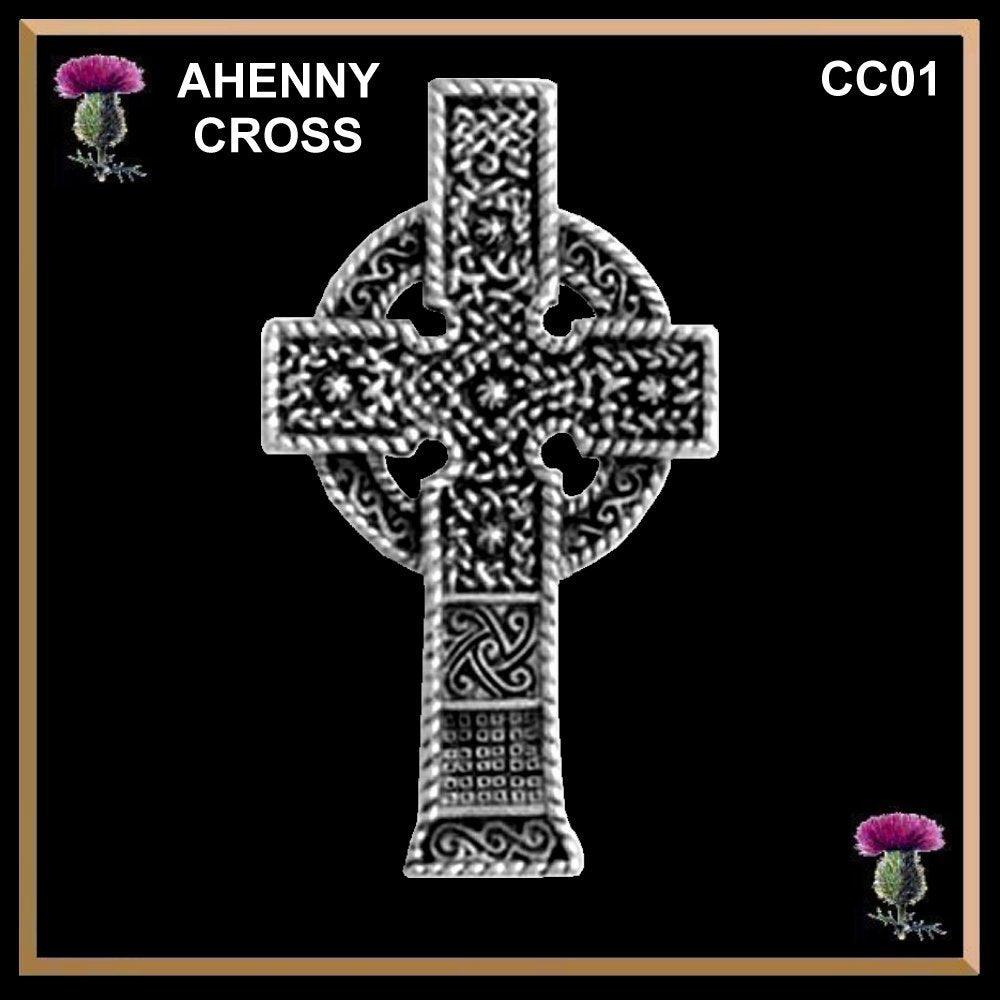
Ahenny Celtic Cross
Inspired by the Irish High Cross tradition and the ornamental language associated with Ahenny.

St. Martin Celtic Cross
A modern jewelry interpretation connected visually with the ring-headed cross tradition of Iona.

Celtic Carolingian Cross
A more ornamental modern design that works well for readers interested in knotwork and interlace.

Celtic Double-Sided Cross
A contemporary wearable interpretation showing how Celtic Cross motifs continue in modern jewelry.
Frequently Asked Questions About Types of Celtic Crosses
What are the main types of Celtic Crosses?
The clearest historical categories are monumental High Crosses and carved cross-slabs. Ringed crosses describe a structural form, while knotwork, scriptural, revival, memorial, jewelry, and tattoo crosses describe decoration, period, or modern use.
What is an Irish High Cross?
An Irish High Cross is a large freestanding stone cross associated with early medieval Christian sites. Many examples are ring-headed and decorated with interlace, figures, biblical scenes, or geometric ornament.
What is a cross-slab?
A cross-slab is a flat stone bearing a carved or incised cross. It differs from a freestanding High Cross because the cross is carved into or onto the slab rather than forming the entire monument.
Is a ringed cross the same as a High Cross?
No. “Ringed cross” describes a cross-head with a circular ring, while “High Cross” describes a monumental freestanding stone cross. Many High Crosses are ringed, but not every ringed cross is a High Cross.
What is a knotwork Celtic Cross?
It is a cross decorated primarily with Celtic-style interlace. Knotwork is a decorative style rather than one separate ancient monument category.
What is a wheel cross?
The term is often used for a ringed or wheel-headed cross. It should not automatically be treated as proof of a pre-Christian sun symbol because the historical origin and meaning of the ring are debated.
What is the difference between historic and modern Celtic Crosses?
Historic High Crosses and cross-slabs belong to specific early medieval religious and artistic contexts. Modern Celtic Crosses adapt those forms for memorials, jewelry, tattoos, décor, and heritage symbolism.
Video: Celtic Cross History and Design