

The Celtic Cross is a ringed Christian cross strongly associated with the early medieval art of Ireland and western Scotland. Its most famous historical forms are the monumental High Crosses raised at monasteries and sacred sites from the early medieval period onward. Today, the Celtic Cross can represent Christian faith, Irish or Scottish heritage, remembrance, continuity, and personal identity.
Popular explanations often describe the ring as a surviving pagan sun symbol or say that St. Patrick combined a sun wheel with the Christian cross. Those stories are widely repeated, but the exact origin and original meaning of the ring are not securely documented. The surviving medieval monuments provide much stronger evidence for the Celtic Cross as part of an early Christian artistic tradition.
What Is a Celtic Cross?

A Celtic Cross is usually recognized by a cross whose arms intersect a circular ring. The term is now used broadly for historic Irish and Scottish High Crosses, later revival monuments, grave markers, jewelry, tattoos, and decorative designs inspired by those forms.
Early medieval Christian form, later expanded into a broader Celtic heritage symbol
The historical monuments are not all identical. Some are covered in biblical scenes, interlace, bosses, animals, and geometric ornament, while others are much simpler. The ring itself is visually distinctive, but it is only one part of a much larger artistic tradition.
For a broader overview of the symbol family around it, see Celtic Symbols and Meanings. For regional and design variations, continue to Types of Celtic Crosses.
Origins and Evolution of the Celtic Cross

The safest historical starting point is the early medieval High Cross tradition. Monumental stone crosses developed at important Christian centres in Ireland and western Scotland, where monasteries were also major centres of learning, manuscript production, metalwork, sculpture, and religious authority.
In Ireland, richly carved High Crosses flourished especially from around the ninth century, with famous examples at places such as Clonmacnoise and Monasterboice. On Iona in Scotland, major ring-headed crosses were being created by the eighth and ninth centuries. These monuments belong firmly to Christian contexts even when their ornament draws on a wider Insular artistic vocabulary.
Historical distinction: the ringed form is real and early, but the exact reason the ring was introduced is debated. Structural support, visual emphasis, symbolism, and artistic development may all have contributed. A single proven origin story does not survive.
Was the Celtic Cross Originally Pagan?

One popular theory interprets the ring as a sun wheel or solar symbol inherited from pre-Christian religion. Another familiar story says that St. Patrick combined the Christian cross with a sun symbol to make Christianity more understandable to converts in Ireland.
These explanations are culturally influential, but they should be presented as later interpretations and origin theories, not established archaeological fact. Surviving Irish and Scottish High Crosses are Christian monuments, and the evidence does not support treating a standardized pre-Christian “Celtic Cross” as the direct predecessor of every later ringed cross.
The Christian High Cross Tradition

Historical High Crosses were closely connected with Christian worship, monastic identity, patronage, teaching, and public religious imagery. Scriptural crosses could carry carved scenes from the Old and New Testaments, including the Crucifixion, Last Judgment, and other biblical narratives.
They were not simply decorative objects. Their scale, placement, inscriptions, and iconography could express religious teaching as well as the status of monasteries and patrons who commissioned them.
What Does the Celtic Cross Mean?

There is no single meaning that applies to every Celtic Cross in every period. Its meaning depends on historical context, design, location, and the person using it.
| Meaning | Context | How certain is it? |
|---|---|---|
| Christian faith | Early medieval High Crosses and later religious use | Strong historical basis |
| Irish or Scottish heritage | Modern identity, memorials, jewelry and diaspora culture | Well-established modern use |
| Remembrance | Grave markers, memorial crosses and war memorials | Well-established later use |
| Eternity or continuity | Modern interpretation of the ring and continuous ornament | Common interpretation, not one universal original meaning |
| Protection | Personal jewelry, devotional or spiritual interpretation | Modern or devotional meaning varies by wearer |
| Solar or pagan symbolism | Popular origin theories focused on the ring | Debated and not securely established as the original meaning |
What Does the Circle Around the Celtic Cross Mean?

The ring is the feature most people use to identify a Celtic Cross. Modern interpretations commonly connect it with eternity, unity, divine presence, the sun, or the joining of heaven and earth.
Historically, however, it is better not to assign one fixed original meaning. On surviving medieval monuments, the ring is part of the cross-head's structure and design, and its practical and symbolic roles may have overlapped.
What Do the Four Arms Mean?

Modern symbolic systems sometimes connect the four arms with the four directions, four elements, seasons, or aspects of human experience. These can be meaningful personal interpretations, but they should not be presented as one documented meaning shared by all early Irish or Scottish cross makers.
Celtic Knotwork Within the Cross

Many Celtic Cross designs include interlace, but knotwork is not required for a cross to belong to the broader ringed-cross tradition. Historical High Crosses can combine interlace with biblical scenes, geometric ornament, bosses, figures, animals, and other decorative forms.
Modern readers often interpret continuous interlace as unity, eternity, or interconnectedness. For the history of the knotwork itself, see Celtic Knot Meaning and History.
The Celtic Cross in Ireland and Scotland

Ireland and western Scotland both preserve major early medieval cross traditions. Their monuments are related through the wider Insular world of monasteries, pilgrimage, sculpture, manuscripts, and metalwork, but individual crosses vary greatly in date, carving style, iconography, and local context.
The Irish High Cross Tradition

Ireland's High Cross tradition produced some of the best-known monumental crosses in Europe. Major monastic centres such as Clonmacnoise and Monasterboice preserve crosses decorated with elaborate biblical imagery and ornament.
Rather than assuming that all Irish crosses followed one style, it is more useful to compare individual monuments, their dates, patrons, carvings, and religious settings.
Scottish High Crosses

Iona is central to the Scottish story. The island became one of the most important Christian centres in early medieval Britain, and its carved stones include major ring-headed High Crosses such as St. Martin's Cross and St. John's Cross. The Kildalton Cross on Islay is another exceptional early Christian example and remains standing near its original setting.
For a design-by-design comparison rather than the overall history, see Types of Celtic Crosses.
Notable Celtic and High Cross Monuments

Several surviving crosses are especially useful for understanding what the historical tradition actually looked like.
| Cross | Location | Why it matters |
|---|---|---|
| Cross of the Scriptures | Clonmacnoise, Ireland | A major early medieval scriptural High Cross associated with one of Ireland's most important monastic centres. |
| Muiredach's Cross | Monasterboice, Ireland | One of Ireland's best-preserved High Crosses, richly carved with Old and New Testament scenes. |
| St. Martin's Cross | Iona, Scotland | An early ring-headed High Cross that still stands beside Iona Abbey and reflects Iona's importance as a centre of Christian art. |
| Kildalton Cross | Islay, Scotland | An eighth-century ring-headed High Cross with elaborate carving, comparable in form and style to crosses on Iona. |
The Celtic Revival, Gravestones, and Memorial Crosses

The Celtic Cross gained another major life during the nineteenth-century Celtic Revival. Designers, antiquarians, artists, churches, families, and public bodies looked back to medieval Irish and Scottish models as expressions of heritage and identity.
Revival-style Celtic crosses became especially common as grave markers and memorial monuments in the late nineteenth and early twentieth centuries. Their use spread well beyond Ireland and Scotland through migration, diaspora communities, churches, cemeteries, and war memorial traditions.
This later revival explains why the Celtic Cross today can function simultaneously as a Christian symbol, a memorial form, and an emblem of Celtic ancestry.
Modern Spiritual and Personal Interpretations

Some people wear or display the Celtic Cross as a devotional Christian symbol. Others use it primarily to represent Irish or Scottish heritage, remembrance, family identity, or a personal connection with Celtic-inspired spirituality.

Protection is a common modern interpretation, especially in jewelry and personal devotional use. It is safer to describe this as a contemporary or faith-based meaning rather than a universally documented ancient Celtic belief.

Likewise, meditation practices built around the Celtic Cross belong primarily to modern spiritual use. They can be personally meaningful without being projected backward as a standard practice of ancient Celtic communities.
The Celtic Cross in Modern Culture, Jewelry, and Tattoos

The Celtic Cross remains highly visible in jewelry, tattoos, grave markers, memorials, church art, logos, and heritage design. Modern examples often combine the ringed cross with knotwork, clan-inspired ornament, gemstones, inscriptions, or other Celtic motifs.
Celtic Cross Jewelry

Celtic Cross jewelry may be worn as an expression of Christian faith, Irish or Scottish ancestry, remembrance, or simply appreciation for the design. Explore the Celtic Cross jewelry collection for pendants and other designs inspired by historic and revival cross forms.
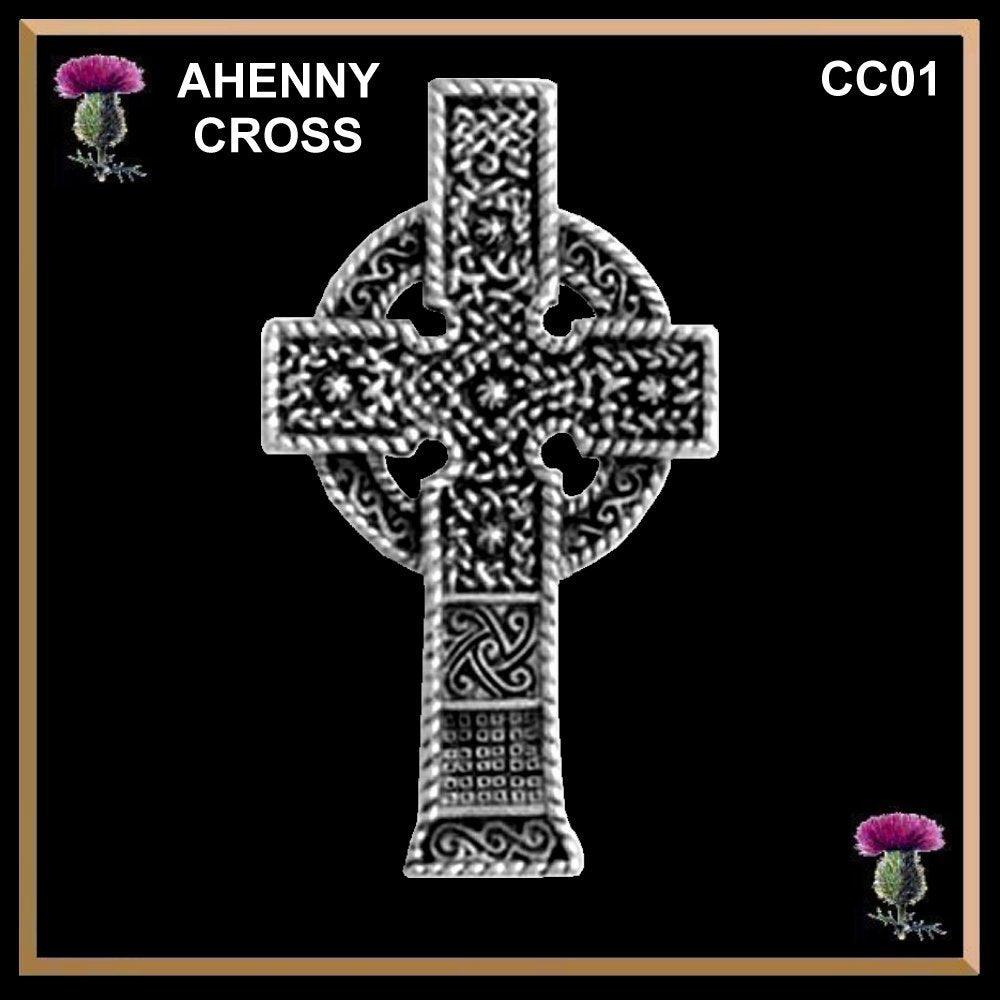
Ahenny Celtic Cross

St. Martin Celtic Cross

St. Brigid Celtic Cross

Celtic Carolingian Cross

Celtic Double-Sided Cross

St. Brigid Large Cross
Celtic Cross Tattoo Meaning

A Celtic Cross tattoo can represent Christian faith, ancestry, remembrance, heritage, personal identity, or a combination of those ideas. Because tattoo meanings are personal, the surrounding design matters: knotwork, names, dates, clan references, scripture, animals, or other symbols can substantially change the intended message.
For the tattoo-specific intent, see Celtic Cross Tattoo Meaning and Designs.
Is the Celtic Cross Tarot Spread Related to the Celtic Cross Symbol?
The Celtic Cross Tarot spread is a separate concept. It is a ten-card divination layout whose name uses the phrase “Celtic Cross,” but its user intent is different from researching the medieval ringed cross, High Cross monuments, or Celtic Cross jewelry.
For that separate topic, see Celtic Cross in Tarot: Meaning and Spread.
Video: History and Symbolism of the Celtic Cross
Frequently Asked Questions About the Celtic Cross
What is the Celtic Cross?
The Celtic Cross is a ringed cross strongly associated with the early medieval Christian art of Ireland and western Scotland. Today it is also widely used as a symbol of faith, heritage, remembrance, and Celtic identity.
What does the Celtic Cross symbolize?
Historically, Christian faith is its strongest documented context. Modern meanings also include Irish or Scottish heritage, remembrance, continuity, eternity, protection, and personal identity.
What does the circle on the Celtic Cross mean?
The ring has several interpretations, including eternity, divine presence, unity, and the sun. Its exact original purpose and meaning are debated, so no single explanation should be treated as certain.
Is the Celtic Cross pagan or Christian?
The surviving medieval High Cross tradition is Christian. Pagan or solar explanations for the ring are popular theories and later interpretations, but they do not establish that the historical Celtic Cross began as one standardized pre-Christian symbol.
Did St. Patrick create the Celtic Cross?
A popular tradition connects St. Patrick with combining a Christian cross and a sun symbol, but this is not securely documented as the historical origin of the ringed High Cross.
What is the difference between an Irish and Scottish Celtic Cross?
There is no simple rule that separates all Irish crosses from all Scottish ones. Individual monuments vary by period, region, carving style, iconography, and local artistic tradition. Ireland's High Crosses and the crosses of Iona and Islay are best understood through specific historical examples.
Why are Celtic Crosses used on gravestones?
The form became especially popular for graves and memorials during the nineteenth-century Celtic Revival and remained common in later memorial design, both in Celtic countries and among diaspora communities.
What does a Celtic Cross tattoo mean?
A tattoo may represent faith, ancestry, remembrance, heritage, protection, or another personal meaning. The surrounding symbols and the wearer's intention determine the more specific interpretation.
Historical Sources and Further Reading
For readers who want to verify the historical background, useful institutional resources include Heritage Ireland's material on Irish High Crosses and Monasterboice, and Historic Environment Scotland's records for Iona Abbey, St. Martin's Cross, and the Kildalton Cross.