

Few symbols are as deeply woven into the identity of Scotland as the Scottish thistle. Recognized for over 500 years as Scotland’s national flower, this humble yet formidable plant has stood as a national emblem of resilience, vigilance, and pride. From medieval battlefields and royal heraldry to modern jewelry and national institutions, the thistle remains one of the most enduring botanical symbols of Scottish heritage.
But how did a prickly wild plant become the badge of a nation?
To understand the Scottish thistle is to explore legend, monarchy, medieval identity, and botanical reality all at once.
What Is the Scottish Thistle?

The plant most commonly associated with Scotland’s national emblem is Onopordum acanthium, often referred to as the Scotch thistle. It is a tall, striking plant characterized by:
- Large, deeply lobed spiny leaves
- Woolly grey-green stems
- A bold purple flower head
- A height that can exceed 6 feet
Although native to parts of Europe and Western Asia, it has long been naturalized in Scotland and has become culturally intertwined with the Scottish landscape.
There is occasional debate regarding whether the true national emblem represents Onopordum acanthium (Scotch thistle) or Cirsium vulgare (Spear thistle). In strict botanical terms, both species grow in Scotland. However, in heraldic and symbolic tradition, the stylized thistle used in royal and national imagery represents the idea of the thistle more than precise taxonomy.
In other words, the thistle as a national flower transcends species classification.
Its symbolic power lies in contrast: fierce defense surrounding a vibrant bloom.
How Did the Thistle Become the Symbol of Scotland?

The Norse Invasion Legend

The most famous origin story dates to the medieval period. According to legend, invading Norse warriors attempted a surprise night attack on a Scottish encampment. To move silently, they removed their footwear.
One of the invaders stepped on a thistle.
His cry of pain alerted the Scots, who rallied and repelled the attack. The plant that had saved them was thereafter adopted as a symbol of vigilance and divine protection.
There is no definitive documentary evidence proving this event. Yet its persistence in Scottish tradition reveals something deeper: the thistle became a metaphor for the nation itself.
Scotland may appear rugged and untamed, but it cannot be taken unchallenged.
Early Historical Use in Scotland

The thistle began appearing in royal symbolism during the reign of King James III of Scotland (1460–1488). It was struck on silver coins and incorporated into royal insignia, marking one of the earliest confirmed uses of the thistle as a national device.
By the late 15th century, the thistle was firmly embedded within Scotland’s emerging national identity.
A Brief Timeline of the Scottish Thistle

- 15th century – The thistle appears on coinage under King James III.
- 16th century – Increasing use in royal badges and court symbolism.
- 1687 – The Order of the Thistle is formally re-established by King James VII.
- 18th–19th centuries – Widespread use in architecture, regimental insignia, and civic heraldry.
This chronological reinforcement demonstrates that the thistle was not adopted in a single moment of legend, but gradually became Scotland’s enduring national flower through royal authority and heraldic tradition.
The Order of the Thistle

One of the highest honors in Scotland is the Most Ancient and Most Noble Order of the Thistle.
Formally established in 1687 by King James VII of Scotland (also James II of England), the order revived earlier traditions believed to trace back to James III.
Its Latin motto:
Nemo me impune lacessit
“No one provokes me with impunity.”
The phrase perfectly captures the thistle’s symbolic meaning. Beauty is not weakness. Defense is not aggression.
The Order of the Thistle remains one of the most prestigious honors in the United Kingdom, second only to the Order of the Garter.
Members wear a star badge featuring St Andrew’s Cross and a crowned thistle, reinforcing the sacred and sovereign dimensions of the emblem.
The Thistle in Scottish Heraldry

The thistle is deeply embedded in Scotland’s heraldic identity.
It appears:
- In the Royal Coat of Arms of Scotland
- As a royal badge under the Stewart monarchy
- Crowned to signify loyalty to the sovereign
- Alongside the Lion Rampant shield
- With the unicorn supporters of the Scottish royal arms
In heraldic art, the crowned thistle represents royal authority and national vigilance. When combined with the unicorn, long regarded as a symbol of purity and strength, the thistle reinforces Scotland’s identity as both noble and fiercely independent.
Architectural carvings of thistles appear in:
- Stirling Castle
- The Palace of Holyroodhouse
- Edinburgh’s medieval closes
- Rosslyn Chapel
Over centuries, its artistic representation evolved from naturalistic depictions to more stylized Renaissance and Victorian forms, yet its core identity remained unmistakable.
What Does the Scottish Thistle Symbolize?

The thistle’s symbolism arises directly from its physical character and historical role.
1. Resilience
It thrives in harsh soil and exposed landscapes, echoing Scotland’s rugged terrain.
2. Protection
Its sharp spines defend what lies at its heart.
3. Courage
The bloom rises boldly from armored leaves.
4. National Pride
It stands upright and unmistakable.
5. Vigilance
Rooted in legend and motto, it warns against complacency.
These layered meanings transformed the thistle from wild plant into national philosophy.
The Thistle in Modern Scotland

Today, the thistle remains visible across Scottish public life:
- The Scottish Rugby crest
- Military and police insignia
- Government publications
- Cultural festivals
- Clan symbolism
- Tourism branding
It is not a relic of medieval romance. It is a living national flower.
Even abroad, Scots and their descendants recognize the thistle as a symbol of heritage, belonging, and ancestral pride.
Botanical Reality vs Symbolic Identity
Outside Scotland, Scotch thistle is often classified as invasive or noxious. In parts of North America and Australia, it is actively controlled.
Yet in Scotland, it is revered.
This contrast highlights a profound truth: symbolism is not dictated by ecology. It is shaped by narrative, memory, and identity.
In Scotland, the thistle is not a weed. It is a guardian.
The Scottish Thistle in Jewelry and Personal Meaning
Because of its layered symbolism, the thistle has long appeared in:
- Brooches
- Signet rings
- Pendants
- Clan badges
- Memorial pieces
When worn, it represents loyalty, endurance, and connection to Scotland’s history.
Unlike purely decorative motifs, the thistle carries historical and heraldic authority. It is a symbol that tells a centuries-old story.
At CelticStudio, the thistle is crafted not merely as ornamentation, but as an emblem rooted in Scotland’s enduring identity.
Featured Scottish Thistle Jewelry

Four Thistle Scottish Amethyst Brooch - Pewter
A bold thistle design with a purple amethyst-style center stone, perfect for scarves, coats, and tartan wraps.
View product
Scottish Large Double Headed Thistle Brooch
A classic Scottish thistle motif in sterling silver with strong detail and a clean, traditional profile.
View product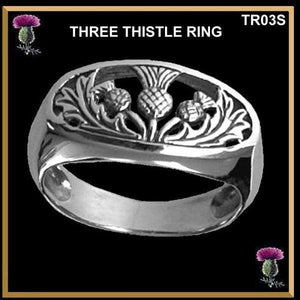
Oval Three Thistle Scottish Ring Sterling Silver TR03S
An oval ring top featuring three thistles. A strong heritage piece with clean lines and comfortable daily wear.
View product
Luckenbooth Double Hearts and Thistle Brooch
A romantic Scottish symbol combining the Luckenbooth hearts with a central thistle, a meaningful gift rooted in tradition.
View productFrequently Asked Questions About the Scottish Thistle
Is the Scottish thistle really Scotland’s national flower?
Yes. The thistle has been recognized as Scotland’s national flower since the late medieval period and formally embedded in royal symbolism during the 15th century.
What does “Nemo me impune lacessit” mean?
It translates to “No one provokes me with impunity.” It is the motto of the Order of the Thistle.
When did the thistle first appear in Scottish history?
Documented royal use dates to the reign of King James III in the 15th century.
Is the Norse invasion story historically proven?
There is no definitive evidence. It is a powerful national legend that reinforces themes of vigilance and resilience.
Why is the thistle purple?
The purple bloom is characteristic of many thistle species and historically associated with nobility and royalty.
The Enduring Power of the Scottish Thistle
The Scottish thistle is more than a flower. It is a declaration.
For over five centuries, it has symbolized Scotland’s strength, sovereignty, and spirit. Crowned in royal heraldry, honored in chivalric orders, and woven into national life, it remains one of the oldest continuously recognized national emblems in Europe.
Like Scotland itself, it endures.